



Apollo 16 lunar surface flown netting – lunar dust coated !
Article No.: a16netting
Apollo 16 Lunar-Surface-Flown Strap
Lunar Dust Coated
Own an exceptionally rare physical connection to one of humanity’s greatest adventures: an authentic fragment of strap material flown to the lunar surface aboard Apollo 16, still bearing visible traces of genuine Moon dust.
This presentation features an approximately 8 mm triangular swatch of Beta cloth strap material, mounted on a rigid 7 × 9-inch display board and individually certified on the reverse.
The Apollo 16 Mission
Apollo 16 was launched on April 16, 1972, carrying Commander John Young, Lunar Module Pilot Charlie Duke, and Command Module Pilot Ken Mattingly. The mission returned safely to Earth on April 27, 1972, after completing the fifth crewed lunar landing in history.
Young and Duke descended to the Moon aboard the Lunar Module Orion, while Mattingly remained in lunar orbit aboard the Command Module Casper. During nearly three days on the surface, Young and Duke conducted three extravehicular activities, travelled across the lunar terrain in the Lunar Roving Vehicle, deployed scientific instruments, and collected approximately 95 kilograms of lunar samples.
Exploring the Descartes Highlands
Apollo 16 landed in the rugged highlands near Descartes Crater, a region selected because scientists believed it might contain evidence of ancient lunar volcanic activity.
The astronauts explored two principal geological areas: the relatively smooth Cayley Plains and the hilly, furrowed terrain associated with the Descartes Formation. Laboratory analysis of the samples revealed that these landscapes were not primarily volcanic, as initially expected. Instead, they consisted largely of material created and redistributed by enormous impact events during the Moon’s early history.
Nearby North Ray and South Ray craters provided access to material excavated from beneath the surface, helping scientists examine the layering and impact history of the lunar highlands. These discoveries significantly changed scientific understanding of the Moon’s geological development.
Why Lunar Dust Is So Important
Lunar dust—often called lunar regolith—is far more than ordinary dirt. It was produced over billions of years as meteorite impacts continually shattered and pulverized the Moon’s surface.
Because the Moon has no atmosphere, wind, or flowing water to soften its particles, lunar dust remains extremely fine, sharp, and abrasive. The grains are also affected by solar radiation and the solar wind, making them scientifically valuable records of the Moon’s exposure to the space environment.
Apollo astronauts repeatedly described how the dust clung to spacesuits, equipment, tools, and material inside the Lunar Modules. It was difficult to remove and became one of the most memorable—and operationally challenging—features of working on the lunar surface.
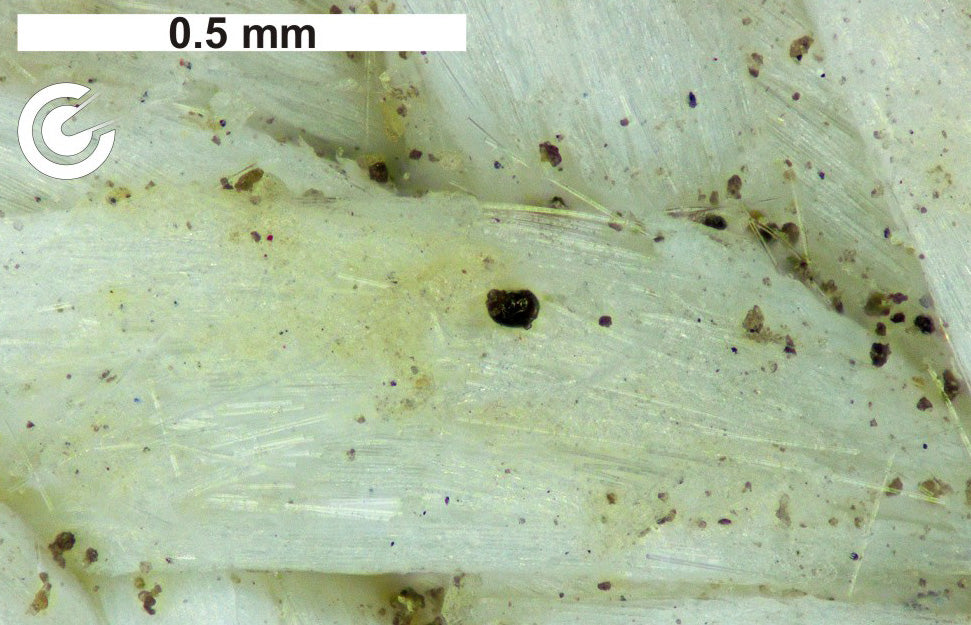
The strap fragment in this presentation retains authentic lunar dust as subtle greyish smudges against the normally white Beta cloth. These traces are visible to the naked eye and become especially striking under magnification. At approximately 60× magnification, numerous individual dust particles may be observed.
Direct Charlie Duke Provenance
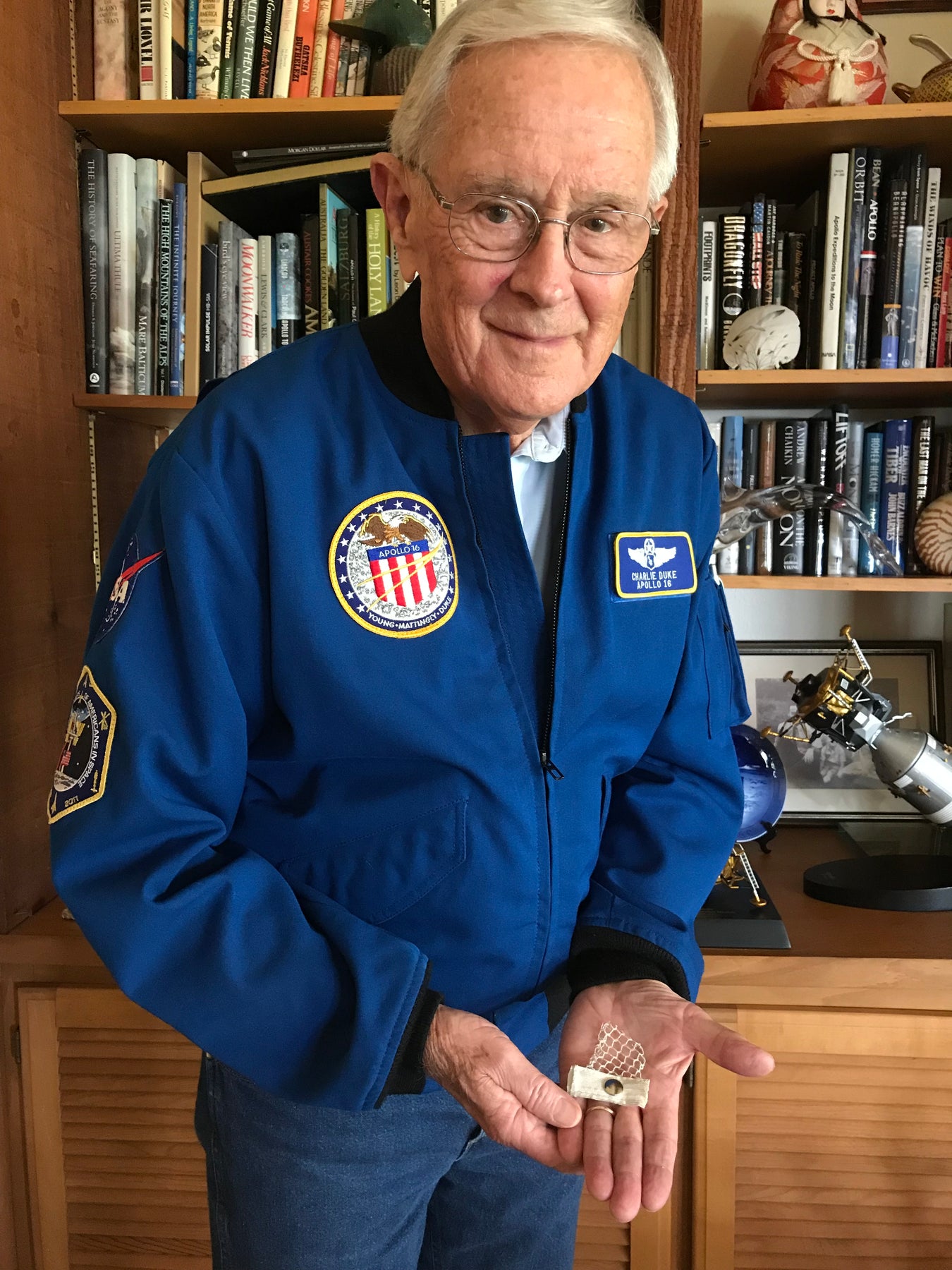
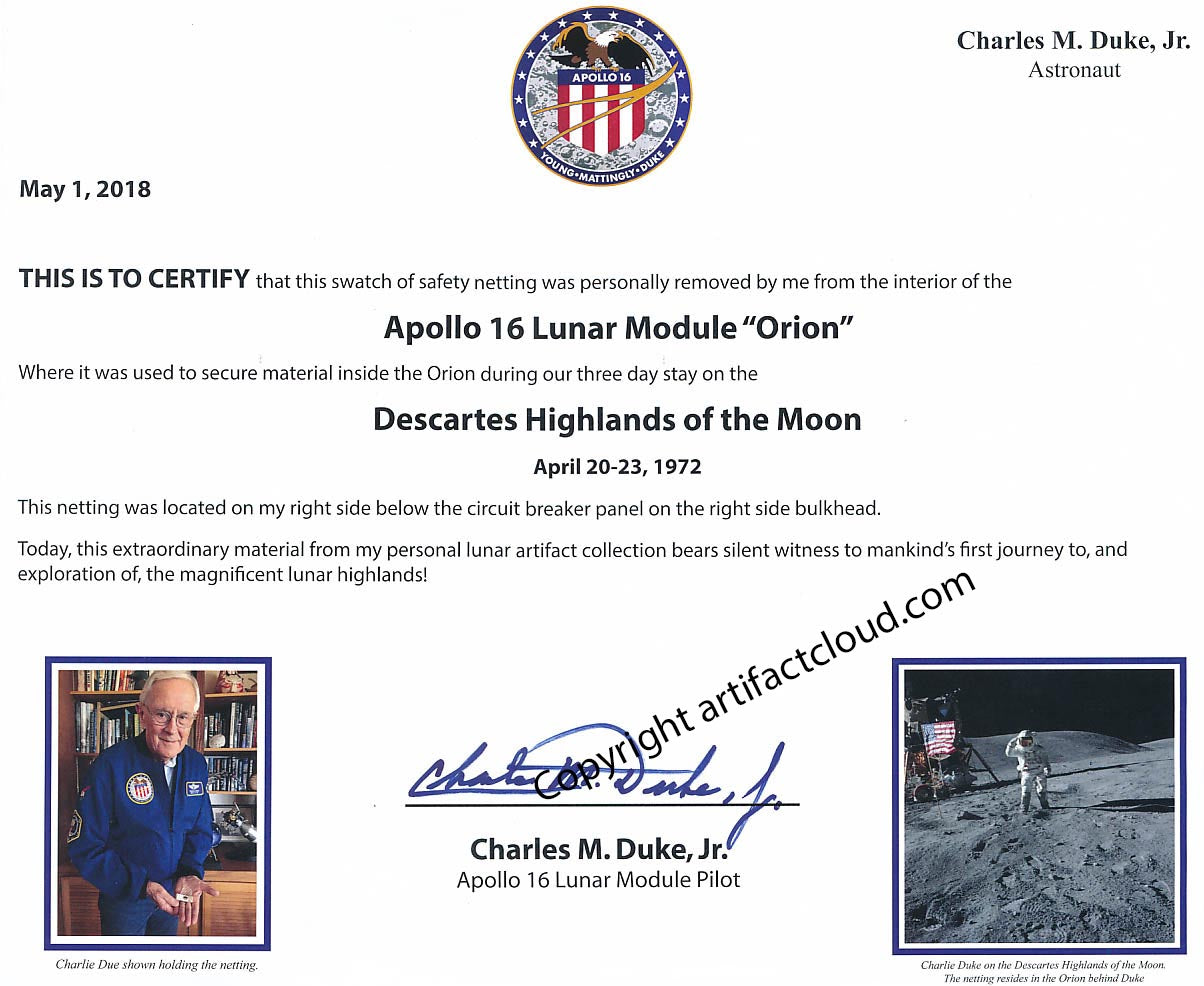
The original strap came from the personal collection of Charlie Duke and was acquired directly from him. A copy of Duke’s letter of authentication documenting the source of the material is included with every presentation.
This exceptional provenance connects the artifact directly to an Apollo astronaut who lived and worked inside Lunar Module Orion and walked on the surface of the Moon.
Limited Collector’s Edition
Only 99 presentations will be produced.
Because every fragment originates from the original flown strap, each example is unique. The precise shape, coloration, fiber pattern, and distribution of lunar dust will naturally vary from one presentation to another.
Authentication
Every presentation produced by BeenInSpace or Artifactcloud is supplied with an attached or separate Certificate of Authenticity and is guaranteed authentic without time limitation. Copies of the original source documentation and supporting provenance are included whenever available.
Important Ownership Notice
The lunar dust offered here remains naturally embedded in and attached to a legally obtained Apollo-era artifact. It is not presented as loose lunar material independently removed from a government-held sample.
A museum-quality collectible combining:
- Material flown to and used on the lunar surface
- Authentic lunar dust residue
- Direct provenance from Charlie Duke’s personal collection
- Supporting authentication documentation
- A strictly limited edition of 99 presentations
This is a remarkable opportunity to own an authentic, dust-bearing fragment associated with the Apollo 16 Lunar Module Orion—a tangible relic from humanity’s exploration of another world.